
Before any trip to Rome’s Trevi Fountain: A Water Oasis, pack light and bring a good pair of shoes. One of the things that I noticed on our trip was the enormous amount of walking that is done and I loved it!!
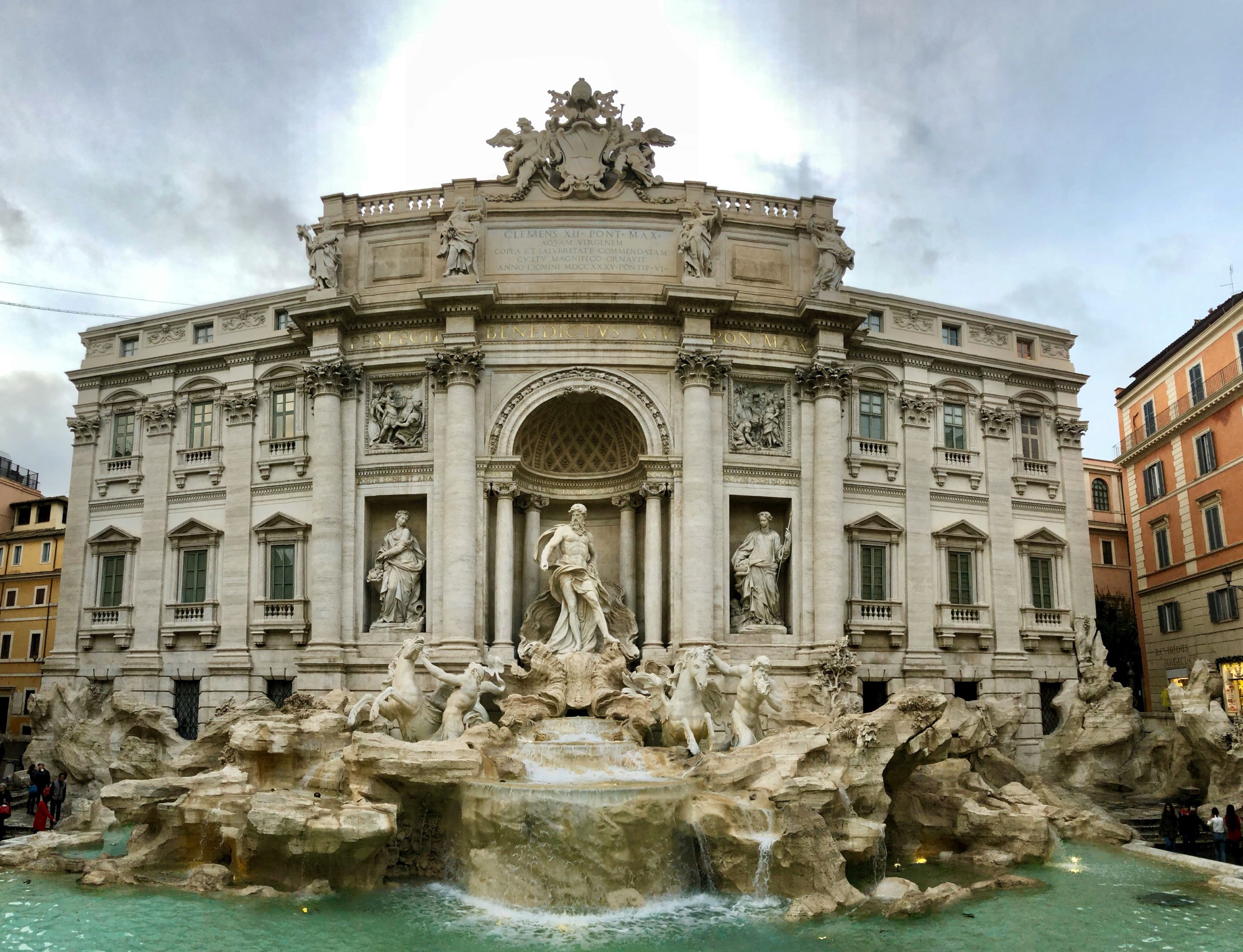
On our trip to Rome with my daughter’s school, the first stop we made before the Colosseum was a visit to the popular Trevi Fountain. It is a beautiful fountain filled with history and crowds flock to see the fountain as evidenced by the following picture.

So why stop by the fountain? The history and beauty of course!
Construction of the Fountain
The construction was started in 1732 and finished in 1762. It was built between two other landmarks, Quirinal Palace and the Pantheon. All three landmarks are situated by popular shopping and restaurants. The material used to build the Trevi Fountain is the same material that was used to build the Colosseum which is Travertine stone.
The Trevi Fountain design was part of a competition that was won by Nichola Salvi. Unfortunately he died in 1751 and the fountain was finished by Giuseppe Pannini. There were struggles both financially and logistically and through the process the fountain was rumored to be cursed!
Salvi won the competition as he came in with the lowest bid which caught the eye of the reigning Pope at the time. The fountain was paid for through the third extraction from the lotto which is ironic to think of as we still have a lotto today. The winning lotto numbers were 56, 11, 54, and 6! I wonder if those numbers are still lucky today!

Statues Galore
In the center of the fountain is not Neptune as commonly thought. The center position is reserved for Oceanus, the Titan God that represents the source of all fresh water on Earth. Oceanus is surrounded in the center by a triumphal arch.
On a step down closer to the water are two tritons which are mythological sea creatures of half-men and half-fish. They are blowing into shells which stand for the power of the sea. The statue to the left of Oceanus represents triumphant while the one on the right represents abundance.
On the central niche at the top of the building depicts Agrippa. He is the Roman general who built the original aqueduct that provided water to the Trevi fountain. There are four figures in total on each side of the central niche that represent the seasons. They are abundance, salubrity (health), fertility, and autumn.


Oldest Water Source and Coins
The Trevi Fountain has the oldest water source in Rome and has 2,824,800 cubic feet of water. The most popular activity is to toss coins in the fountain. The coins fund social welfare programs that total up to millions of Euros annually. Approximately 3,000 Euros are thrown in the fountain daily and it is illegal to steal the coins or go swimming in the fountain.
The urban legend is you throw the coin with your right hand over your left shoulder into the fountain. The first time you throw a coin, you will return to Rome with good luck. The second time you will return to Rome and find romance. The third time you will return to Rome and will get married to the one standing next to you. That wound be fun to do! I myself didn’t have any coins that day!
What made the Trevi Fountain famous worldwide?
For those individuals that have been unable to visit the fountain in person, Hollywood has made that easier to see via the movies. There are four movies that were filmed in Rome and around the Trevi Fountain. They range in different decades and are Roman Holiday, La Dolce Vita, Angels and Demons, and Lizzie McQuire. While in Rome, my daughter and I saw Tom Hanks and the cast filming Angels and Demons. Being a Tom Hanks fan, it was a thrill of a lifetime!!
As a sign of respect, the fountain was shut down with the water drained and a black drape was placed across the fountain when actor Marcello Mastroianni passed away. The only other time that the fountain changed was when a vandal poured red in to the water system to turn the whole fountain red. Luckily, the act was discovered early on and the stone in the fountain was not stained.
If you are ever in Rome, make sure to stop by the Colosseum and Trevi Fountain for amazing world landmarks. Stay tuned for upcoming blogs on Pompeii, Saint Peter’s Basilica, and the Vatican!!
Sources:
Visiting Trevi Fountain: The History of Rome’s Most Famous Fountain published in contexttravel.com





Leave a Reply